NDIS Debt Notices: What to Do in the First 14 Days (A Provider’s Response Playbook)
Got an NDIS debt notice? Use this day-by-day playbook to assign an owner, build your evidence pack, decide your response and fix the root cause.
An NDIS debt notice is the NDIA’s written statement that a claim you were paid for should not have been, and that money is owed back. What you do in the first 14 days decides whether it is resolved cleanly or drags on for months. This playbook gives you a day-by-day plan: who owns the notice, what evidence to pull, how to choose between agreeing and disputing, and how to respond in writing.
New debt recovery provisions (Schedule 3, Part 5 of the Securing the NDIS for Future Generations Act 2026) commence on 20 February 2027, so the time to build this process is before your first notice arrives, not after (source).
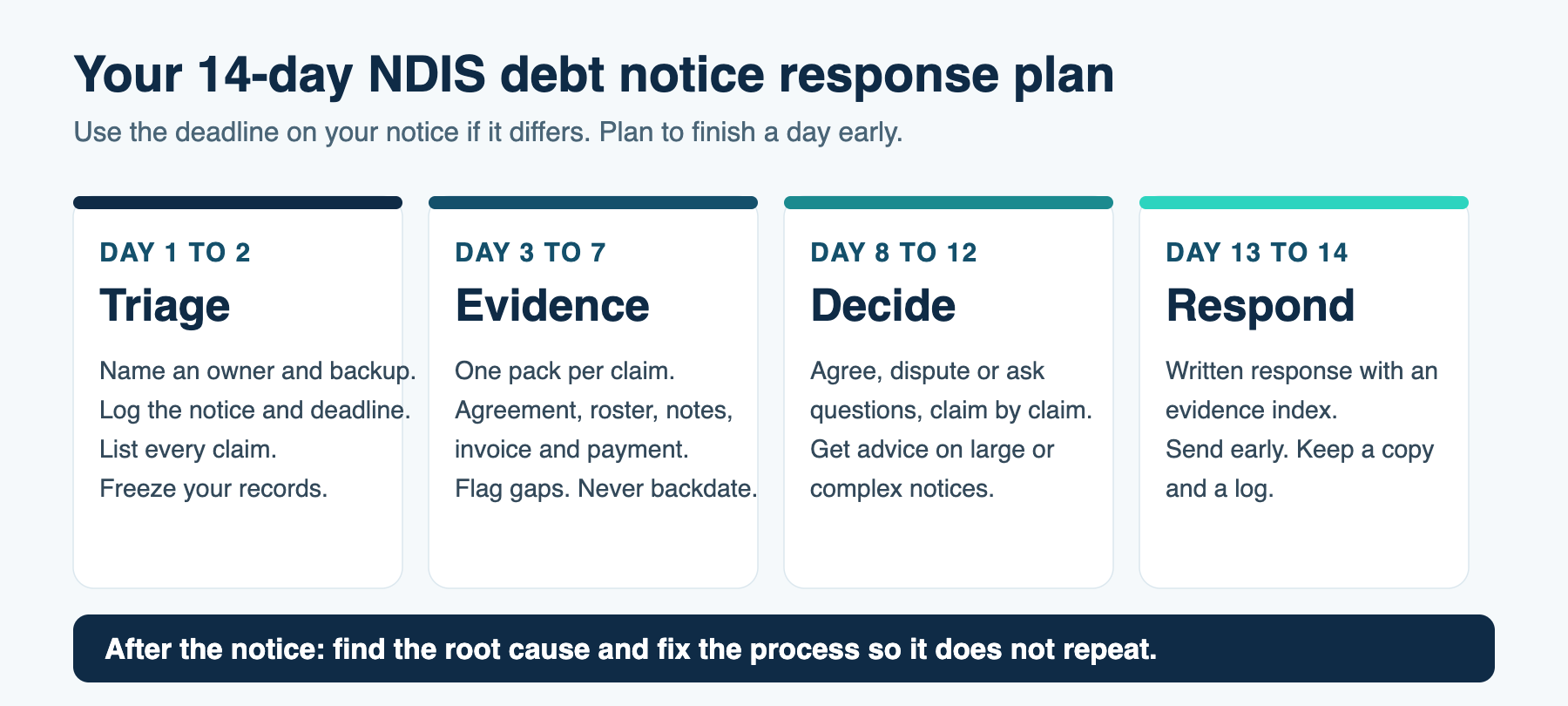
Your 14-day plan at a glance.
The 14-day window is a planning frame. If your notice states a different response time, the notice wins, so adjust the plan to fit it.
What is an NDIS debt notice, and what triggers one?
An NDIS debt notice is the NDIA’s letter telling you it believes you were paid for a claim you were not entitled to, and setting out the amount it wants repaid. The NDIA says it will send a letter with details of the debt and will contact you before it looks to recover it (NDIA: debt management and recovery).
Common triggers include:
A claim with no matching record of the service being delivered.
A claim at the wrong rate, or under the wrong support item.
A duplicate claim, or a claim for a date outside the participant’s plan.
A notice is not a final verdict. In its own review of provider debts, the NDIA reported about 387 provider debts under review, with refunds expected to go to fewer than 60 providers (NDIA: debt review). It also says NDIA-initiated debts are now reviewed and approved by two panels that include legal specialists and senior executives. Notices can be wrong, and they can be right, so your first job is to find out which.
What changes on 20 February 2027
Schedule 3, Part 5 of the Act, headed “Debt recovery”, commences on 20 February 2027 (the Act, section 2 commencement table). Check the NDIA’s updated guidance for the exact notice and response rules once it is published. Until then, the current process applies. For the other key dates, see our NDIS compliance deadlines for FY27.
Day 1 to 2: assign an owner and confirm what you are being asked
The goal of the first two days after an NDIS debt notice arrives is a one-page triage note that anyone in the business can read and understand. Do not start arguing the merits yet.
Name one owner and one backup. Usually this is your operations or compliance lead, with a director kept informed.
Log how and when the notice arrived. Record the date, the channel (letter, email or portal), who received it and the response deadline it states.
List every claim named in the notice. Capture the claim reference, service date, participant, support item, amount claimed and amount the NDIA says is owed.
Freeze your records. Pause any routine deletion or clean-up of files, notes and emails linked to those claims.
Hold off on changing anything in the portal. The NDIA says that if you cancel a claim after it has been paid, you will need to repay the amount (NDIA: debt management and recovery). Decide your position first.
Tell the people who need to know. That may include your director, your insurer if your policy requires notice, and your accountant.
Do not contact participants to “fix” notes or ask them to confirm services you have not yet checked against your records.
Day 3 to 7: build the evidence pack for each claim
When an NDIS debt notice arrives, build one pack per claim, so each one can stand alone if the NDIA asks about it. Work through the claims in order of dollar value, largest first.
Evidence
What it proves
Where it usually lives
Service agreement
The participant agreed to the support, rate and terms
Participant file or CRM
Roster or timesheet
A named worker was scheduled and worked
Rostering system or payroll
Progress or shift notes
The support was delivered on that date, for that duration
Case notes system
Invoice
What you billed and when
Accounting system
Claim and payment record
What you claimed and what was paid
NDIS portal and bank records
Cancellation record
Why and when a short-notice cancellation was claimed
Booking system and messages
Plan details
The support fell inside the plan dates and budget
Participant plan on file
For each pack, write a short summary with the claim reference, the support delivered and a plain statement of what the evidence shows. If a document is missing, say so in the summary. Never backdate a note or recreate a record to fill a gap. A late note must carry today’s date and say what it relates to.
Day 8 to 12: decide whether to agree, dispute or ask questions
Once each pack is built, take a position on every claim in the NDIS debt notice separately. A single NDIS debt notice can contain claims you should accept and claims you should challenge.
What your evidence shows
Likely position
What to include in your response
The claim was wrong (for example a duplicate or wrong rate)
Agree
Acknowledge the error, the corrected amount and how you will repay
The service was delivered and the evidence is complete
Dispute
The evidence pack index and a plain explanation of why the claim stands
The service was delivered but the records are thin
Ask questions or dispute in part
What you hold, what is missing and why
You cannot tell from the notice what the issue is
Ask questions
A request for the specific basis of the debt for each claim
You agree but cannot repay in one payment
Agree and ask for an arrangement
Your proposed instalments
The NDIA says you can ask it to review a debt if you think it made a mistake, and you can ask for an invoice or a payment arrangement, including paying in instalments or using future payments to reduce the balance (NDIA: debt management and recovery). The NDIA also says providers can ask it to reconsider the circumstances of a debt, which may include revoking, waiving or writing it off (NDIA: debt review).
Be aware that the NDIA says it cannot waive a debt that arose from a false or misleading statement or from not complying with the law. That is one reason to be accurate about what happened.
When to get advice
Get advice from a lawyer or an experienced NDIS compliance adviser before you respond if any of these apply:
The total is large or the notice covers many claims.
The same issue appears across many participants, which suggests a systemic problem.
The notice suggests a claim was false or misleading.
A participant disputes that the service happened.
You are unsure whether to admit an error.
This post is general information, not legal advice.
Day 13 to 14: respond in writing and keep a record
Send your NDIS debt notice response at least a day before the deadline, so a failed email or a missing attachment does not cost you the window. Use the contact method the notice names and a channel you can prove.
A strong written response has six parts:
Reference details. The notice date, any reference number, your organisation name and your contact person.
A position on each claim. Agree, dispute or request more information, claim by claim.
A short factual explanation. What happened, in plain words, with no speculation and no blame.
An evidence index. A numbered list of the attachments for each claim.
A clear request. For example a review, a corrected amount, a waiver request or a payment arrangement.
A named contact. One person who will answer follow-up questions.
Share only the participant information you need to support each claim.
Then close the loop on your side. Save the exact response you sent, the attachments, the sending date and time, and any acknowledgement. Diarise a follow-up date. If the NDIA does not reply, you have a record showing you responded on time.
After the notice: find the root cause and fix the process
Resolving the NDIS debt notice is half the job. The other half is making sure the same issue does not produce the next one. Within 30 days, trace each claim in the notice back to the step in your process that let it through.
Root cause
Fix
Claim submitted with no matching delivery record
Require a completed shift note before a claim can be invoiced
Wrong rate or support item
Check each claim against the current NDIS Pricing Arrangements before submission
Duplicate claims
Use unique claim references and a weekly duplicate check
Service outside plan dates
Verify plan start and end dates when the plan changes
Cancellation claimed without evidence
Record the notice given and the reason at the time of cancellation
Notes written days or weeks late
Set a deadline for notes and report on overdue ones
Then put a routine in place. Pull a small random sample of paid claims every month and test them against the same evidence pack you would build for a notice. Because the NDIA is also looking harder at older claims, as covered in our post on increased checks on older NDIS claims, that sample should include claims from well before the current quarter.
Write the lessons into your incident or continuous improvement register. If you are ever audited, a visible fix is a good answer.
Evidence pack checklist (one per claim)
☐ Claim reference, service date, participant and amount recorded
☐ Service agreement, with rate and terms, on file
☐ Roster or timesheet showing the named worker
☐ Progress or shift note for that date and duration
☐ Invoice issued to the participant or plan manager
☐ Claim and payment record from the portal and bank
☐ Cancellation evidence, if a cancellation was claimed
☐ Plan dates and budget checked
☐ Gaps listed honestly, with no backdated records
☐ One-paragraph summary of what the evidence shows
How long do I have to respond to an NDIS debt notice?
Use the deadline stated on your notice. This playbook plans for 14 days so that you finish with time to spare. New debt recovery provisions start on 20 February 2027, so check the NDIA’s current guidance for the response time that applies to you.
Can I dispute an NDIS debt notice?
Yes, you can dispute an NDIS debt notice. The NDIA says you can ask it to review a debt if you think it made a mistake.
Can I pay an NDIS debt in instalments?
You can ask the NDIA for a payment arrangement, which may include paying in instalments or having future payments reduce the balance.
Can the NDIA waive a debt?
NDIS law allows a debt to be waived in some cases, including small debts. The NDIA says it cannot waive a debt that arose from a false or misleading statement or from not complying with the law.
Should I cancel the claim in the portal?
Not before you have decided your position on the NDIS debt notice. The NDIA says you must repay the amount if you cancel a claim after it has been paid.
Do I need legal advice?
For large or complex NDIS debt notices, or where a claim may be said to be misleading, yes. This post is general information only.
Need a hand with your claims records?
Wholii helps NDIS providers tighten their claims and record-keeping so a notice is easier to answer. Talk to our team or download the evidence pack checklist.
Disclaimer: This article provides general information about responding to an NDIS debt notice and does not constitute legal or compliance advice. It reflects our understanding of the National Disability Insurance Scheme Amendment (Securing the NDIS for Future Generations) Act 2026 and NDIA guidance at the time of writing, and legislation, guidance and NDIS Commission practice may change. Providers should confirm their obligations against the current legislation and the notice they receive, and seek independent professional advice before making decisions about how to respond to a debt notice. Wholii accepts no liability for actions taken on the basis of this article.